

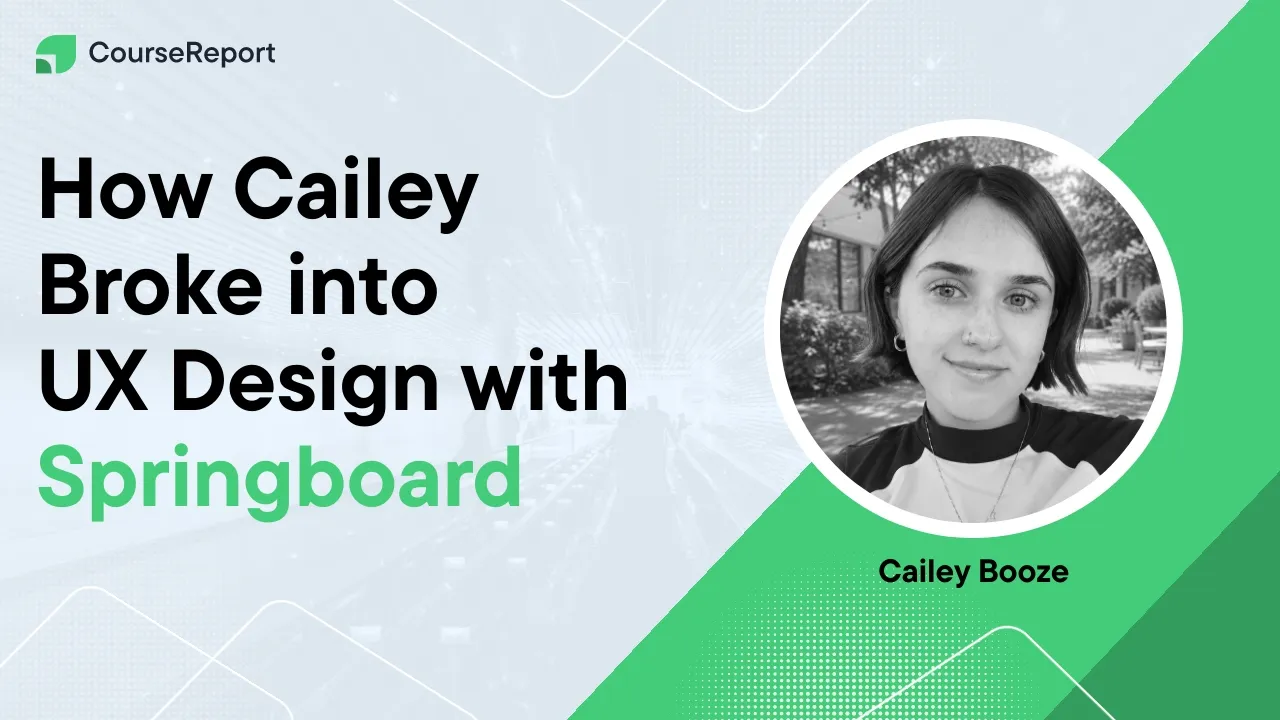
Cailey Booze was studying interior design at the University of North Texas when she realized that her favorite parts of design – problem solving and research – pointed toward UX. Rather than push her graduation back two years, she enrolled in Springboard's UX/UI Design Career Track while finishing her design degree and working a summer internship at Sabre. Cailey graduated from Springboard in April 2026 and is now a full-time UX designer at Applied Concepts. She tells us why a LinkedIn message did more than about 150 applications to land her current job, how she uses AI at work today, and why networking may matter just as much as design skills.
Cailey, what were you doing before you decided to pursue UX/UI design, and what led you to Springboard?
Originally, I was doing interior design at the University of North Texas, and it didn't really feel like quite the right fit. I knew that I liked design, but there were parts of the process of the design projects that just didn't feel like the right fit. I found myself really enjoying the initial stages of the project, like the problem solving and the research parts of design. So I started thinking that UX design might be a better fit.
But I didn't necessarily want to change my major to UX at UNT; I would have had to push my graduation date back by about two years. So I did some research, and I found that UX designers come from backgrounds like psychology, or even complete career pivots, like economics. So I knew that I would be able to do it with a different degree, and the fact that I was working on a design degree provides a good foundation. So I made the decision to go ahead and pursue a bootcamp through Springboard and also work on my design degree at the same time.
It's definitely not a requirement, but a degree in design seems like it could put you a step ahead of a lot of people working in UX design. Did it help?
It definitely helped having the design foundation. I feel like I didn't really have to tackle learning design principles as much as other students who came from a completely different background. So it was very helpful.
Which design principles and frameworks – things like color theory?
Yeah, I would say so – layout, color theory, basic graphic design principles and frameworks.
Now that you've been working in UX for a bit, is there anything else that overlaps with interior design?
My favorite part about interior design was that I did a lot of space planning. Basically, the architects would give you the shell of a building, and then you would figure out how to lay out the interior of the floor plan based on how people would use it. So in a way, it is UX, right? Because you're designing for the user and how they'll be using the space. That was really what got me thinking maybe UX would be a better fit.
What was your research process, and what made you choose Springboard?
Something that I did was go through LinkedIn. There are a lot of bootcamp grads who are working at Google, Meta – working everywhere, right? So I just went through and looked to see what other people were doing, and Springboard was very popular. I also did some research on the website and looked at how much it costs. I thought that it was a really good program that had a lot of good ratings and was also very affordable. That was something that stood out to me, because I was also paying my college tuition at the same time. And like I said, there were a lot of designers who had done Springboard as well, so I knew it was a reputable company.
You were finishing your BA at UNT while doing Springboard. What did the day-to-day look like?
I started at the beginning of the summer, so that was very helpful. But something unexpected happened. I was intending to only be focusing on the bootcamp for the first three months of the summer, and then I would have to acclimate to doing school full-time and the bootcamp at the same time.
I had been applying for internships, and I hadn't gotten one by the time summer had started, so that was another reason that I decided to go ahead and go through with it. But then I got a call from Sabre – the biggest GDS in North America. I decided to accept an internship offer through Sabre, so I interned at Sabre over the summer of 2025 and did Springboard at the same time.
Were you an interior design intern or a UX design intern?
It was actually a digital design intern. It was an internship where I got to do UX and graphic design at the same time, which was really nice. But I was working full-time and doing the bootcamp at the same time, so I had to be very disciplined with my time. It was really time-consuming.
Who was your Springboard mentor?
My mentor was Mo Touman. He works in UX design. He was amazing. I would highly recommend him.
What did you learn in the Springboard curriculum? And how much was AI a part of it?
At the time, I actually wasn't using a lot of AI. Using AI is really important, especially right now with how the industry is. You have to be able to keep up with how it's evolving, otherwise you're going to get rooted out. But as somebody who was trying to build my basic UX practices, I didn't want to replace my thinking with AI. So I was really trying to make sure that I was doing it myself first, and then building on top of that, which I've been doing in my current full-time position. I use a lot of AI at work.
I think it was very beneficial for me to learn the basics – UX research, UX thinking, how to build the interfaces myself – and then, on top of that, start implementing AI, because it's a good foundation to have.
Is that the approach Springboard led you toward?
I don't recall being encouraged to use AI a whole lot in the program. I imagine they would have put a module in there by now with how the industry is at the moment, and I think that they absolutely should. That was something that I had to learn myself. I knew how the market was and what I was getting myself into, so I knew I had to stay on top of the trends.
What tools did the curriculum cover?
Figma, absolutely. They gave us the option of using either Figma or Adobe XD, but I chose Figma because, through my research, I knew that Figma was the industry standard. Through all of the applications I had put out, I rarely came across a company that was using Adobe XD over Figma.
I do wish that somebody had really pushed me to learn the basics of Figma – LinkedIn and YouTube tutorials on how to use auto layout, how to make components, what variants and instances are, how to do prototyping. When I started my internship, I realized how much of Figma I did not know. It is very much teachable – you can absolutely teach yourself. I'm sure it was in there somewhere and I didn't see it, but that's something that I wish somebody had encouraged me to do more.
I used to use Adobe Creative Suite a lot in college, but now that I'm focusing on UX, I only use Figma.
Is there a project from the program that you're especially proud of?
My first capstone project. I chose the problem of food waste in the kitchen. Through the research that I did, I actually ended up pivoting the direction of the project. I wanted to solve the issue of food being wasted in the kitchen, but through my interviews, I found that that actually wasn't an issue with users. People were more concerned with their time and how much time it takes them to cook for their family. So I had to pivot my project based on that.
That definitely wasn't something that I was expecting, and I think that's part of UX. Maybe you have an assumption of how the project is going to go, but it could pivot in a completely different direction. It taught me that I really needed to stay open-minded and be able to pivot with the user.
Did you ever work with other Springboard students on projects?
For my industry design project, I worked with a group of four designers from Springboard, including myself. We worked with the CEO of a startup based in Canada, doing some UX work on his admin dashboard.
What were your mentor sessions like?
I met with him every two weeks and would update him on where I was. I would tell him what I had gotten done, where I am, and what I'm thinking, and he would help me know where to take the project further. Sometimes I would get stuck on certain little parts, because I was new to the process, and he would help push me in the right direction. With his nudge, I was able to start going again by myself.
He would also help me if I had some basic UI questions, but for the most part, he was guiding me in the right direction. It's really nice to have a mentor help you figure out which way you're supposed to go, because it can be a little overwhelming trying to do it by yourself.
Did you discover what kind of designer you wanted to be? Did you ever weigh UX versus UI?
Not within the bootcamp. That came with my internship – working in a real company, in a real setting. That was when it became very clear that I really enjoy the logic and the thinking behind it, rather than just the visual part of it. I do enjoy the visual part, but the strategic "how is it supposed to work" is what I enjoy the most.
What happened after your Sabre internship ended?
I stayed unemployed for a couple of months, and then I became a digital marketing assistant for one of the schools at my college. I did that part-time while I was finishing up my degree and my certification – a little bit of marketing work and some graphic design that was helping support and strengthen my skills. I did not receive the offer from the company that I'm at now until March, two months before I graduated.
Were you actively job searching while you finished your degree?
Yeah, I was. A couple of months after I finished my internship, I knew that I needed to get started, because with the market now, you need to start looking immediately. It took me about 200 applications before I got Sabre, and then about 150 before I got my current company, Applied Concepts.
You knew what the job market was going to be like going in. Did you expect it to be a slog?
When I discovered UX, I really couldn't see myself doing anything else. I had the feeling that this was what I'm meant to be doing. I knew the job market was bad, but I knew if I didn't try, I would regret it. So I made the decision to go ahead and do it, and it ended up working out. I'm really glad that I did.
How did you actually land your role at Applied Concepts? What was your secret?
At Springboard they really emphasize networking and how important it is. When you listen to them, you're like, "Yeah, I have to network." But they're really not kidding. I might even go as far as to say that networking could be just as important as learning how to be a good designer.
While I put out all those applications, I was also pushing myself to network with as many designers as I could – just saying hi and introducing myself. I found somebody on LinkedIn who graduated from the same college with the same degree as me, and she's a UX designer. So I reached out to her and said, "Hi, I'm Cailey. I'm in the same boat that I'm thinking you probably were a year ago. I just wanted to connect, maybe hear about your experience."
She was the one who reached out to me and told me that she would like to recommend me for the job – before I even applied. If they hadn't told me how important networking was, it wouldn't have turned out this way.
What was the UX interview process like?
I didn't find it extremely challenging. They did not ask me to do a whiteboarding challenge. I did a phone call with the hiring manager and the manager of the team that I would be on, and then they invited me for an in-person interview. I walked them through my portfolio and talked about my projects, but it was also kind of a vibe check, for them to see if they liked me and my personality. It depends on the company, though. They definitely could have asked me to do a design challenge, and I think it's important to be prepared to do that.
Did you have your design portfolio ready to go?
I did. I've actually redone that portfolio three times now. I feel like I've finally gotten it to a point where I'm really happy with how it looks, and across every portfolio I've built, you can see the progress.
Are you still an intern at Applied Concepts, and what are you working on?
I'm a full-time employee now. The company produces traffic device hardware – the signs you see on the side of the road that tell you to slow down if you're going too fast, and devices that pick up traffic data. I've been working on web applications that connect to those devices and let you extract data from them.
You mentioned that you use a lot of AI on the job. What does that look like for a UX designer?
I use Claude Projects a lot. My whole team has a Claude project for the project that we're working on, and we feed it all of our documentation and all of the logic. It knows everything about what we do – what was said in every single meeting – and we instruct it to act as our UX advisor.
I'll ask it whether my flow is making sense, and it helps me ideate on different ways that I could make a flow, or different ways a screen could be laid out. I also use it for copywriting, like the text on a toast message or a button. That one is super helpful, because that might be something that takes a lot of time, but using AI to help with that is very quick and easy.
What was the process of going from intern to full-time employee?
There wasn’t much of a process. I think 90% of their interns get converted to full-time – they hire you as an intern to convert you. They want to see how you work with the team and whether you're a good fit, and it's also for you to figure out whether you even want to work there. That was really a blessing.
How large is your team?
There are three of us. Very small team.
Now that you have some distance, would you say Springboard was worth the investment?
Absolutely, it was worth it for sure. I changed my degree from interior design to design management, because it was more of a versatile design degree, and I decided to focus in on UX through the Springboard bootcamp. I was learning the basics of design through my degree, and then Springboard was layering on top – learning the UX principles and how to be a UX designer. Without it, I would have had to teach myself. If you have the resources and you're able to do the bootcamp, I think it really is worth it, because you have people helping you and you're not isolated by yourself trying to figure it out.
It sounds like you used both your degree and Springboard to build your career?
Yeah, I did use both. Nowadays I think it's really, really hard to find a job without having a degree. It wasn't something where I knew it had to be a certain degree – people come from an array of backgrounds. I also didn't need the certification to become a UX designer, but I personally needed it to get to that point, to be able to say that I'm a UX designer and I know how to do UX design.
What advice do you have for somebody who's about to start the Springboard UX program?
You need to network. You might be able to do this without networking, but I think it's going to be much, much harder. Reach out to five people a week and introduce yourself, because you never know where an opportunity is going to come from. I would also say learning Figma is very important, and just reaching out for help and putting yourself out of your comfort zone.
Personally, I hate networking. But I forced myself to do it. I primarily used LinkedIn, and I just messaged random people. I didn't go to any in-person events, actually. If you truly do want something, you have to be willing to put in 110%. You can't just do it on the side and be like, "I think it'll work out." You have to put your whole heart into it and be able to look back and know that you did everything possible to make it happen.
Find out more and read Springboard reviews on Course Report. This interview was produced by the Course Report team in partnership with Springboard.

Written by
Liz Eggleston, CEO and Editor of Course Report
Liz Eggleston is co-founder of Course Report, the most complete resource for students choosing a coding bootcamp. Liz has dedicated her career to empowering passionate career changers to break into tech, providing valuable insights and guidance in the rapidly evolving field of tech education.



Comments
No comments yet. Start the conversation.
Sign in to join the conversation.
Sign in to comment