

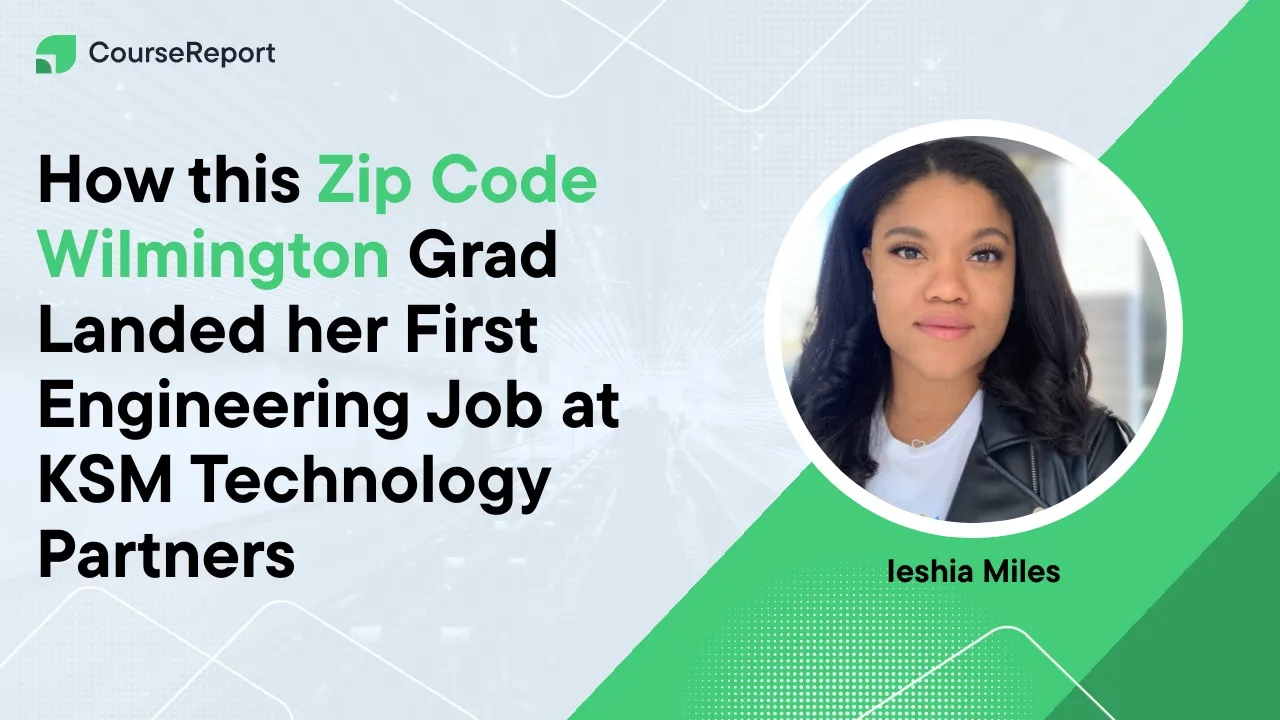
Today we’re talking to Ieshia Miles, a recent graduate of Zip Code Wilmington's Data Engineering and Analytics program. She graduated in January 2026 and is now working at KSM Technology Partners. We'll learn why she chose Zip Code Wilmington, what the program was actually like, how she landed her first role after graduating, and whether the experience was worth it.
Let's start with your background. Can you tell us what you were up to before you went to Zip Code Wilmington?
Ieshia: Before Zip Code Wilmington I had no experience in tech. I have my bachelor's degree in exercise science and kinesiology, but after school I dabbled in different career choices. I worked for a nonprofit as a program coordinator for a mother-baby program, and then right before Zip Code I was working for the State of Delaware, reaching out to daycares in our local community. I was also running a kids' party rental business on the weekends while being a mom. So those are the kinds of things I was doing before Zip Code.
So what made you decide to change your career and move into tech, or into data engineering specifically?
Ieshia: It was honestly a couple of years back that the idea started to spark in my mind. The first thing I'd say was when I was with the nonprofit – we were still handling everything via paper and manually, and I was thinking, it's 2024, we have technical solutions that could really help us with the people we're serving, just to gather their information and make decisions. So I started looking into different tech avenues and software, and I realized I wanted to be part of the team building these solutions, not just using or consuming them, but actually building them. That was the initial spark. The second piece was my business – I had to use so many different tools because I was a one-woman shop, doing everything from customer service to packaging to cleaning. So I started to see how useful software and information could be. And the reason I was drawn to data specifically is because at the nonprofit we were constantly collecting information about the people we served – their demographics, where they live, their jobs – and I thought, if this information could be stored in one place, how many different solutions could we build for the people we serve? That's really why I went into data engineering.
How Ieshia Chose Zip Code Wilmington
There are a lot of bootcamps today – what ultimately made you choose Zip Code Wilmington?
Ieshia: For me it started with just a quick Google search – what's around? I saw there were online bootcamps, but I knew I'd benefit from in-person instruction, so I was looking for something local. I had two family members who'd both gone through a bootcamp in Delaware, and when I asked about their experience – even though they'd both become successful – they pointed to Zip Code Wilmington. That was confirmation for me to look into it more. It was really just talking to people who are now in the tech industry, and they were all pointing in that direction. When I looked into Zip Code more, I realized it wasn't just a bootcamp – it was very well-rounded. People talk about the people you meet, the networking, the professional development. It seemed like a program that cared about your whole career, not just teaching you to code.
Did you feel like the admissions process was competitive? Did you have to study for the application, or was it pretty easy to get in?
Ieshia: Zip Code is definitely highly competitive. Interestingly, I actually have two experiences with the admissions process. A year before I joined, I was considering it, and back then the admissions process involved learning JavaScript and taking a test on it – Zip Code offered a pre-course where you could study and prepare. Unfortunately, I was one of those people who psyched myself out before the test. It was my first experience coding, I got nervous, and I didn't even take the test. The next year, I was determined not to let the test define where I was. The test is really just an initial gauge of where you're at. So I came back – the test was still around – and the day before I was scheduled to take it, we all got an email saying the test would no longer be required for admissions. Instead, they'd base it on an interview process. We went through several interviews with different members of the team – group interviews, individual interviews – and that determined the selection process. So it wasn't hard exactly, but it is competitive. A lot of people go through that interview process. It's really about learning who you are as an individual, your learning skills, your critical thinking skills, and how you work as part of a team – and that will get you further than anything.
Liz: I was just talking to Dan Stabb from Zip Code, and he mentioned they cut that technical requirement – I think that happened right around when you were interviewing.
Ieshia: Yes, absolutely. I believe our cohort was the first cohort where they took away the test.
Inside the Zip Code Curriculum
So then you're enrolled – this is late 2025. Tell us what you learned in the Data Engineering and Analytics program. What did the curriculum cover, what did you spend the most time on, what do you feel like you came out of it knowing?
Ieshia: You jump right in at Zip Code – your very first week you're working with your team on a project. What I loved about Zip Code is that it was project-based, so it wasn't just learning how to code, it was learning how to work as a team. As a data engineering student, our main programming language is Python, so we focused a lot on that, but on the data analytics side we also learned different frameworks – pandas, SQL, how to query APIs, and how to work with databases. It was very project-based, both individual and team projects. Sometimes we'd also work alongside our Java cohort, which let us experience what the software engineering students were experiencing and how to communicate with them on a team – which mirrors what you actually do in the workforce, rather than just learning to code in isolation and not knowing how to work with a team once you're in the real world.
That's definitely true, and it's cool that you got to work in person with the Java cohort. Was there one project you're especially proud of, or that helped you grow the most while you were at Zip Code?
Ieshia: The project I'm really proud of is our passion project. This was a project where we got to choose our own topic, and since I'm very interested in community work and nonprofits, I got to build something I'd wished I had at my previous employer. Using what I'd learned and some AI assistance, I built software to maintain client information and also predict needs – you'd put in inventory information, and based on what the system was seeing week to week, it would help identify, say, that you need more size-two diapers versus size-four, or more formula. That was extremely cool to me, partly because it's something I'm passionate about, but also because it took me beyond data engineering – it was a full-stack project, so I got to work on the back end, the front end, and the database. It was a really valuable experience.
You were at Zip Code into January 2026, learning at a time when AI was rapidly reshaping software and data roles. Did you find AI was incorporated into the curriculum?
Ieshia: Absolutely – AI was incorporated immediately, but very strategically. In those first few weeks, they didn't want us relying on AI. We were taught to use it as a teacher's assistant. We had lectures, but there's always more to cover than what fits in a lecture, so we'd use AI to enhance our understanding of concepts, or when we got stuck on a project. The typical move used to be Google and Stack Overflow, but now we had an AI tool that could look directly at our code. That was really helpful early on. As we got more comfortable with our coding skills, we started using AI more like a coworker – building code together. I loved that it was used strategically, that we weren't encouraged to use it to write our code right away, just to learn first. Now it's still my teacher's assistant, and my personal assistant too.
We used Claude the most, though we'd also use ChatGPT whenever our tokens ran out, or Gemini. Toward the end we also used Microsoft Copilot, so we got to experience several different AI tools.
Ieshia's Job Search
Let's talk about the job search and technical interviews. Did Zip Code have a dedicated part of the program for career services, or was that baked into the curriculum? When did you start thinking about a job?
Ieshia: The career search was definitely baked into the curriculum. We had Meet the Expert sessions – someone from, say, a bank or BlackRock would come in directly, and that was our first introduction to a company, whether or not they happened to be hiring at that moment. We also had professional development days with interview prep and mock interviews with past alumni or other members of the community. But what really solidified the career search was Demo Day, where we present our group and individual projects and Zip Code invites employers from different sectors to come see us – another chance to meet employers in the area one-on-one. And after graduation, our career services team – Cassie – would send us job openings, especially with Zip Code's direct partners, but also other opportunities outside of that, and help with our resumes. So we were ready with a well-built technical resume to send to employers.
Amazing – and it sounds like a classic in-person bootcamp experience, where you actually get to meet people in the community and meet people who could be hiring. That's such a benefit, and it's great to hear they're still doing that.
Ieshia: It really is such a benefit. For me, and for a lot of my cohort mates who don't come from technical backgrounds, this was an introduction to fields we'd never even considered – some of us had never thought about banking or investments. That introduction really helped us see the different directions you can go in tech.
So you graduated in January 2026, and now you're working at KSM Technology Partners – congratulations! And you're working in software engineering.
Ieshia: Yes – a surprising turn of events.
How did you find out about this role, and did Zip Code play a part in connecting you with KSM? Tell us about landing the job.
Ieshia: It goes back to Demo Day. KSM has been a partner with Zip Code for a while, and they brought several of my now-colleagues out to our Demo Day to see us present. Afterward, they all stuck around and interviewed us. One of my now-colleagues came up to me and said they typically look for software engineers – I didn't think I'd be considered for that kind of role, but I thought, they're really nice, I'll still talk to them. So we talked, they asked about my passion project and our group project, and there was a real warmth and curiosity about what and how we'd learned. I had an open conversation without any expectations, and a couple of weeks later I got an invite for my first interview.
That's so cool – those relationships matter so much and it's great that they came to Demo Day. When you got your first interview, did you feel prepared for the technical parts of the process?
Ieshia: Nerve-wracking, to say the least. I'd say KSM's interview process is a bit atypical compared to other employers. There was a technical interview, but the second round was more built around a project – myself and the other colleagues who were hired at the same time each got to present a project we felt strongly about. They'd already looked at the code base, and then interviewed us based on what they'd seen we were capable of through that project. It was nerve-wracking, and there were moments where I felt like my answers could have been stronger, but I was talking about something I was genuinely passionate about. I think that – expressing passion and a willingness to keep learning and developing – played a bigger role in getting me hired than the technical skills alone.
Working in Tech Today
Without giving away any company secrets – what are you working on now? What kinds of problems are you working on, and what's your day-to-day like as a software engineer?
Ieshia: What I can share is that at KSM, at least in my role, I work directly with pharmaceutical companies, building applications they use for their statistical environment – working on different features they can use. I had experience in the cohort working with Java, and with data pipelines behind the scenes, but this role is really cool because I get to work full-stack – on the back end, where I still get to use Python, but also on the user interface, so I get front-end experience too. I'm also a consultant, so I'm building both my technical skills and my soft skills – people skills, interacting with clients and describing something technical to me in terms a layperson can understand. It's really cool.
You get to interface directly with clients – that's awesome.
Ieshia: Yes – it's really cool, and it's something Zip Code used to point out all the time. They would always remind us to use the skills from our previous careers. We talked a lot about imposter syndrome, and I think all of us have probably experienced that even in our roles at KSM. What I try to remember now is that maybe I'm not as technically strong as someone who's had years in the field, but I do have other skills, and I try to pull from those when I'm not feeling my best at work.
Absolutely. How many Zip Code students got hired at KSM?
Ieshia: Including myself, it was five of us – which is pretty significant. I'd say we're all on fairly separate paths, except maybe two of us, but we still keep in touch. There's definitely a heavy Zip Code presence at KSM, so we keep in touch as a cohort, and with other Zip Code alumni at the company too. That's another thing I wanted to bring up about Zip Code – they made it a priority that we learned how to use our cohort, not just within data but across data and Java, to help each other succeed. None of us knew five of us would get hired, but we're still doing that same cohorting now – keeping in touch, asking what projects people are working on, what they're learning, giving each other demos and help, and using our individual strengths to keep helping each other.
Is this what you expected when you decided to change careers and do Zip Code? Are you happy with your day-to-day?
Ieshia: I'm extremely happy with my day-to-day. I think I've landed in an amazing company, not just an amazing field. I can't speak for other companies, but for me, working somewhere small, with really intelligent people who see helping you grow and learn as an opportunity rather than a burden, has been amazing. So nothing's really been surprising, other than just how helpful people are in helping you learn, grow, and keep going. I hope people from other cohorts are having a similar experience at their companies, because I think that can take you further than almost anything. I always say everything is doable – you just need the right resources, tools, and people around you to learn it. It's extremely challenging at times, but I feel like I have the tools to keep me going day to day.
And did it take basically a year from applying to getting the job, or was it a little shorter than that?
Ieshia: A little shorter – I started the application process in August of last year, and I was hired by February.
Looking back, is there anything you would have done differently during the program, or during your job search, or anything you wish you'd learned at Zip Code, now that you've been in the industry for a few months?
Ieshia: I think I would have used the resources around me sooner. You get into Zip Code that first week and you're so focused on becoming the best coder you can be that you forget about the resources around you that can help propel you faster. For me, that would've meant reaching out to instructors sooner – when they ask if you have questions, have questions, because that's your chance to talk to people with direct access to the career field. I think hands-on conversations and projects are the best thing you can do, and I wish I'd leaned into that sooner – including with the Meet the Expert speakers. Zip Code encourages you to message MTE speakers on LinkedIn, thank them, and go beyond that – talk about something you learned or found exciting when they came in, and try to have an actual dialogue, because it's the networking and the relationships that get you further. I'd have used those resources immediately. And afterward, I'd say the thing I'd keep doing is maintaining a schedule – the same kind of structure Zip Code requires – for your job search. Even if you're not lucky enough to meet an employer directly, you can treat it like a nine-to-five: the first few hours for job searching, a couple hours for networking, whatever moves you forward. And don't forget to keep honing your skills – if Zip Code only brushed the surface of something like Docker, use that as a moment to go back and build that skill further.
How much AI are you using on the job now as a software engineer? Does KSM have policies around it, or is it a real part of your workflow?
Ieshia: It's cool, because KSM is actually talking through how to use AI across the whole company right now, but we're given the ability to use it. I use it the same way I described before – as a teacher's assistant. I'm not putting in any proprietary information, but I'll use it to help me understand a concept better when I'm not sure about something. We also learn pseudocoding, so there are times I'll ask AI to help me build a generic project if we're using a particular framework – say, Plotly Dash or something – just to enhance my learning on a tool we use at KSM, without touching proprietary information. We're exploring as a company how to use AI with the data and information we've collected over the years, to help both incoming and longer-tenured colleagues find information. It's really cool to be part of that growth and see where it's going.
For sure, it's a very interesting time. But you're still coding in Python – that's still part of your day-to-day workflow?
Ieshia: Yes.
Was Zip Code Wilmington Worth It?
Good for people to know. So, finally – Zip Code is an investment, both tuition and time and effort, in changing your career. Looking back, would you say Zip Code Wilmington was worth the investment?
Ieshia: One thousand percent. I'd tell anyone – if you're interested in entering the world of tech, Zip Code should be the number one place you go. And I'm not just talking about people in Delaware, but anywhere, because Zip Code isn't just about coding – it's about developing you as a whole person, in multiple areas. If you want to completely change your life, Zip Code is the place to be, because you'll grow so much from being in this program.
Find out more and read Zip Code Wilmington reviews on Course Report. This article was produced by the Course Report team in partnership with Zip Code Wilmington.

Written by
Liz Eggleston, CEO and Editor of Course Report
Liz Eggleston is co-founder of Course Report, the most complete resource for students choosing a coding bootcamp. Liz has dedicated her career to empowering passionate career changers to break into tech, providing valuable insights and guidance in the rapidly evolving field of tech education.


