

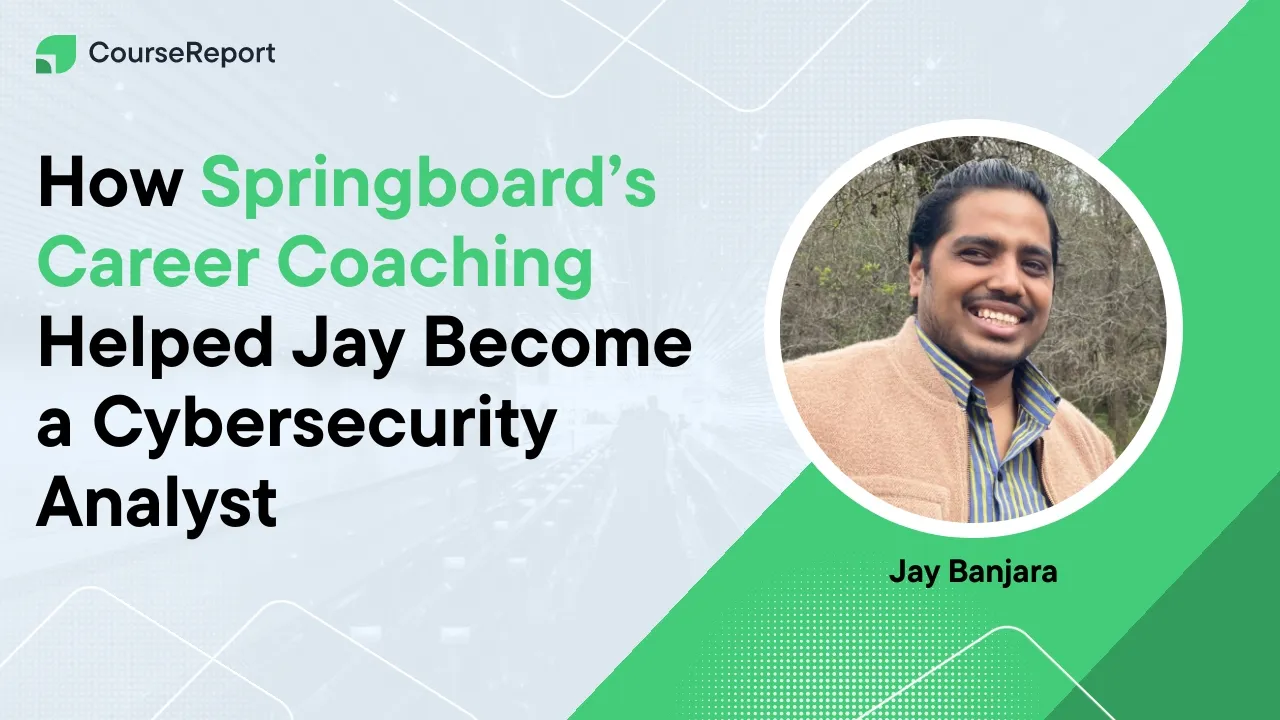
Jay Banjara already had a bachelor's degree in Cyber and Computer Forensics and Counterterrorism from Bellevue University – and had applied to ~900 jobs with no luck – when he enrolled in Springboard's Cybersecurity Career Track. He finished the bootcamp, earned his Security+ certification, and now works as a Cybersecurity Analyst at Texas Health and Human Services. Jay explains why he added a bootcamp on top of a degree, how the two compared, how he landed his job, and what his work looks like now.
What were you doing before Springboard, and what first drew you to cybersecurity and computer forensics?
Jay: My life was a bit of a roller coaster after I moved to the States from Nepal in 2019. Back home I'd been a manager at an insurance company, but when I got here I didn't know what to do. I worked at a juice bar in New York for a few months. Then COVID hit, and we moved to Austin.
In Austin I worked at Walmart, which has a program called Live Better U that pays for employees to go to school. My path to cybersecurity started with a Google search for "which jobs pay the highest salaries." Out of the options, cybersecurity was the one that clicked for me.
Before the bachelor's, I did a seven-month cybersecurity diploma through Purdue Global and passed with a good score. Around then the job market started getting harder, so I figured a bachelor's would help me get hired. I already had a bachelor's in business management, but it wasn't helping in this field. Walmart was paying, so I went back for a bachelor's in cybersecurity and graduated in March 2025.
After that I applied to a lot of jobs and wasn't hearing back. I volunteered with an IT hiring firm to get some experience. To be honest, I needed a job badly. Since I already had the bachelor's and the diploma, I looked for the cybersecurity bootcamp that would help most with the job search, and that's how I joined Springboard. Things started getting on track after that.
You really took advantage of that education benefit at Walmart! That's a lot of education in five or six years.
Jay: I did it all in four years. I started in 2022, when we had our oldest daughter, and in 2023 we had twins, which was another big challenge. I was the only one providing for the family while I studied. But I finished everything with the highest honors, a 4.0 GPA in every semester and every course. It was a lot, but we finally got here, and it was worth it.
What did Springboard give you that your degree and diploma didn't?
Jay: The course material wasn't that different. What I was missing when I applied for jobs before was discipline: applying consistently and connecting with people. Springboard didn't do that for me. I still had to do it myself. But someone was always behind me reminding me that this was a job guarantee program. If I didn't meet my obligations, like applying to a set number of jobs or connecting with a set number of people, I could lose the job guarantee. That gave me a clear track to follow, and I stayed on it. I think that's why it got easier to focus only on the job search. The coaches kept me on track, and the metrics helped a lot.
You still did the full Springboard curriculum, even though a lot of it was probably review for you. Did you have any cybersecurity certifications when you started, or did you earn any during or after the program?
Jay: I didn't have any when I started. When I enrolled, Springboard required me to pass the Security+ exam. I already had the knowledge, so I worked through the course and prepared. At the end of the program I took the Security+ exam and passed on my first try.
Amazing. Have you earned any other certifications since then?
Jay: No, I got Security+ in February 2026, so it's still pretty new. I finished Springboard in February 2026, started looking for jobs, and got my job in August. For those six months I focused on the job search, not more certifications. Now that I have the job, once my beginner training settles down in a few months, I plan to get a few more.
Which certifications are you looking at next?
Jay: CISA right now, and after that CISSP. Those are the two I want, but I haven't started studying yet. I work for the State of Texas Health and Human Services now, and they have a program for certifications and exam prep, so I'll take advantage of that.
Who were your mentors at Springboard? Did you have one mentor the whole time?
Jay: I had one mentor for the curriculum and a separate career coach. My career coach was Holly Hall.
What were the labs and projects like in the cybersecurity program?
Jay: The capstone project was the big one, and I did really well on it. We used all the standard tools, like Wireshark, Nessus, and TryHackMe, and there were quite a few others. The capstone had the biggest impact on my learning. It was a lab environment where we did a virtual penetration test.
I came in with a cybersecurity background, and not everyone will. But even someone without a cyber background can do it if they pay attention to the project. I'd say the capstone is a really good project at Springboard.
It sounds like the career coaching and job search support were where you got the most out of Springboard. How did they prepare you, and what did that guidance look like during your search?
Jay: The big issue was that I'd already applied to 800 or 900 jobs by then, and I was worried I was doing something wrong. A lot of the time I felt demotivated. Some days I thought I'd have to start over, and other days I wondered if I'd ever get a job at all.
At that point my career coach was a big source of motivation. A career coach won't do the job search for you. You do it yourself, and the coach keeps you on track. I also got calls from a couple of companies saying, "Pay us and we'll apply to jobs for you, and you pay us more when you get hired." Springboard never did anything like that, at least not with me.
I can proudly say I got this job through my own hard work, with help from my Springboard career coach. Nobody found a job and handed it to me on a silver platter. I earned it, but Springboard played a big role in keeping me on track to get there.
Now you're a Cybersecurity Analyst at Texas Health and Human Services. Congratulations! How did you land the role? Did you find it on LinkedIn, apply the normal way, or get a warm introduction?
Jay: This was my second or third interview with the State of Texas. I found the job on LinkedIn. I used Glassdoor, Handshake, and plenty of other sites, but LinkedIn became my main source because it had almost everything, and it was easier to make connections there. About 80% of my job search happened on LinkedIn. My routine was: see the position, find the company, find people who work there, apply, and then connect with those people. I did that before and after my regular job every day.
Did you feel ready for the technical and non-technical parts of the interview process?
Jay: On theory, I was fully prepared. I answered every theory question like a pro. Then they asked about tools: which cybersecurity tools I'd used and which ones I was most comfortable with.
I didn't lie. I told the panel, who are my bosses now, that I do have experience in cybersecurity. I know the controls and can work with them, I've written security policies for a company, and I've used a lot of tools in lab environments. But I told them I hadn't used their tools on the job yet. Since I know the concepts, I'd pick them up quickly once I started. I said I didn't want to lie to them, so I was being upfront. I think that honesty was one of the big reasons I was selected.
What does a Cybersecurity Analyst at Texas Health and Human Services do day to day?
Jay: My life has turned upside down! A lot of it is challenging. I went from lab environments, theory, and writing security policies to actually mapping controls against evidence and assessing the security posture of systems across an organization.
It's a lot. Of course, learning takes longer compared to how easily my peers do the work. That hasn't stopped me, though. I believe in myself and in what I've learned. I'm learning the organization, the tools, and the process. I'm confident I'll finish on time, and starting next quarter, I'll be a pro.
Now the question everyone wants to ask: how much do you use AI at work?
Jay: AI is part of every organization now, including HHS. We have an approved AI tool, and you can use it as a reference. But if you use AI to produce something, you have to disclose that to whoever receives the document. You can't just use AI.
Maybe it's good luck or bad luck, but new hires this season haven't gotten access to the AI tools yet. Everything I'm doing right now is manual, but eventually I’ll get access to the AI tool as well.
That said, AI won't do your whole job while you just operate it. That's not how it works. Everyone uses AI to some extent, but it isn't replacing the job.
It's probably nice to do your first months of training without those tools so you really learn the work manually. Looking back, was Springboard worth it?
Jay: Financially, I'm only about a month and a half in, so it's too early to see a return. That will take a while. But why did I do a bootcamp after my degree? To get a job. Did I get a job? Yes. So the short answer is yes, it was worth it.
Maybe I could have gotten a job without the bootcamp, but I didn't get a job back then, and now I have one. What changed between last year and this year? Springboard. There was always someone keeping me on track, and I'll always be grateful to everyone at Springboard for that.
Your story is unique because you didn't start Springboard as a beginner. You used it mainly for the job search and career coaching. What advice do you have for someone about to start at Springboard?
Jay: Here's how I thought about the job guarantee program. I did the Career Track, finished it in about nine months, and earned my Security+ certification. If you search for a year after that and don't find a job, you get your money back. Then you have your money and your certification, and all you've lost is that year. You don't lose any money if you don't get a job. So I don't think it's a bad investment, as long as you meet the program's obligations and follow them properly. Either you get a job or you get your money back. One of those is guaranteed. So I'd say the Springboard bootcamp is worth it.
Congratulations, Jay! You really made the most of Walmart's education benefit and got yourself here. Thank you so much for sharing your story, and good luck as your cybersecurity career grows.
Find out more and read Springboard reviews on Course Report. This interview was produced by the Course Report team in partnership with Springboard.

Written by
Liz Eggleston, CEO and Editor of Course Report
Liz Eggleston is co-founder of Course Report, the most complete resource for students choosing a coding bootcamp. Liz has dedicated her career to empowering passionate career changers to break into tech, providing valuable insights and guidance in the rapidly evolving field of tech education.


Comments
No comments yet. Start the conversation.
Sign in to join the conversation.
Sign in to comment