
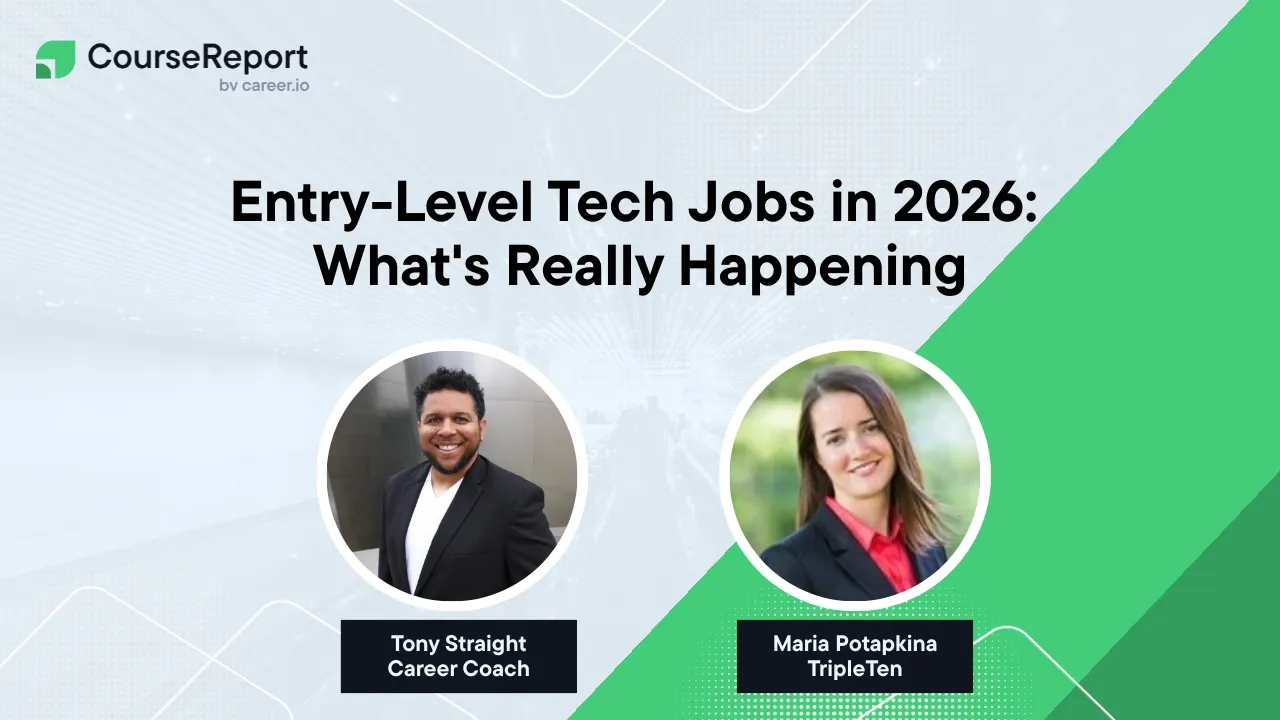
Entry-level tech jobs look a lot different in 2026 than they did just a few years ago – and the headlines aren't making it any easier to know what's real. To get a clearer picture of what's actually happening on the ground, we spoke with Maria Potapkina and Tony Straight from the Career Services Team at TripleTen. They work directly with students navigating today's hiring landscape and share what employers are actually looking for, where entry-level opportunities still exist, and how career changers can position themselves to land that first tech role.
Maria & Tony, tell us about your backgrounds in career coaching and how you work with students at TripleTen.
Maria: My background combines education, consulting, business strategy, and applied AI. I have a PhD in economics and an MBA, and I'm also the founder of Balanse, focused on AI strategy, workflow transformation, and operationalizing AI inside organizations.
At TripleTen, I work with students who are transitioning into tech and AI-enabled careers – many of them coming from very diverse backgrounds.
Tony: I've been in tech for the past 16 years. I'm a career coach at TripleTen and I work across all the verticals – QA, data analytics, AI, automation, all of them. I started in tech sales, then spent eight years in HR doing talent acquisition for the Department of the Navy. I bring a lot of that experience to our services here when it comes to resumes, branding, and networking. My goal is to give students the tools they need to succeed in a tough job market – and a big part of that is building their confidence, especially for folks who've never worked in tech before.
Are most of your students looking for entry-level positions when they graduate, versus mid or senior level?
Tony: About 80% are looking for something entry level – though the definition of "entry level" has changed a lot. The other 10-20% already have some industry experience and are really looking to improve their skills with a certification. They're targeting mid to senior roles.
Maria, can you define what entry level actually means today.
Maria: When I work with students at TripleTen, a lot of them have backgrounds in finance, marketing, and so many other fields. The definition of entry level has evolved quite a bit – today it no longer means zero professional experience. It means early-stage capability within a new field, and specifically within AI right now. Students transitioning from different backgrounds – whether they’re transitioning from operations, logistics, healthcare, marketing, or leadership roles – are leveraging AI capabilities in the new companies or fields they want to work in.
The “entry-level tech jobs are disappearing or being replaced by AI” headline – what are those headlines getting right or misunderstanding about what’s going on in the job market?
Tony: Personally, I think it is rage bait. It scares a lot of people out of really trying to change careers. What I actually see happening is that the market is requiring people to develop AI fluency and to tie their transferable skills into what they can offer. A lot of these folks are coming from industries like healthcare or finance, and they're learning a new skill through a bootcamp – but they still have transferable skills that will put them above someone with no experience whatsoever. Teaching people how to leverage those skills is a big part of what we do, and that's becoming just as much of a buzzword as AI itself.
What does that entry-level tech job market look like for a bootcamp grad right now? Are you seeing junior developer, junior engineer, intern, apprenticeship roles?
Maria: What we're seeing is that the entry-level tech market is becoming more selective, but also more capability-driven and AI-enabled. Positions are increasingly defined in detail by the companies themselves. You'll see titles like "AI-Enabled Specialist" or "AI Trainer" – but when you look inside the job description, there's a very specific list of what they expect. It's not just "we need someone who knows AI." Companies increasingly expect candidates to understand how AI tools integrate into real workflows and operations - not just how to use chat interfaces.
It's become more demanding for graduates, but that's also where the real opportunities are.
Could those job titles – AI Specialist, AI Integration Specialist – can those technically be entry-level roles now?
Maria: Yes, absolutely. After completing a bootcamp, students can definitely be successful in those jobs. When I say entry level in this context, I'm envisioning someone who already has a professional background in another field – marketing, finance – and is now entering the AI space. They can genuinely perform in those roles.
TripleTen teaches AI Automation, Cybersecurity, Data Analytics, QA Testing – are any of those in particularly strong demand right now?
Tony: AI, cybersecurity, and data analytics are some of my favorites right now, because I really think the transferable skills students bring from other industries allow them to hit the ground running. They can find those entry-level jobs and actually qualify for them – and feel confident applying. That's a big piece of it. I get the question "should I apply to this?" constantly. And my answer is almost always yes. You're capable of doing the majority of that job. Apply.
When do you start working with a TripleTen student – from day one, or closer to the end of the curriculum?
Tony: It's within the first month they start the program. We work on getting a plan together – developing a unique value proposition so they can speak to people about what they're doing and what they're working toward. That includes their resume, their LinkedIn, and their overall branding.
What's a realistic timeline right now for graduates to land their first entry-level tech job?
Maria: The timeline varies significantly based on a lot of factors – prior experience, networking ability, consistency in applying, geographic flexibility. I've seen students land a job while they were still in the bootcamp because they were so active and kept applying. And I've seen students take quite a bit of time after graduating. Every situation is different.
Tony: It really depends on the person and their willingness to be creative. It's not just about applying – it's about working on projects and making sure people know about that work, whether that's writing articles, sharing your GitHub, or just talking to people. I've seen it pay off before graduation, and I've seen it take several months after. My goal is to keep students motivated through that process – through the imposter syndrome, through the burnout.
Are there other ways that career services at TripleTen is evolving in 2026 to match where the market is?
Maria: One big thing I'm seeing is that a lot of candidate and resume screening is now being done by AI initially. And at the same time, we're seeing a lot of resumes created by AI. So it's essentially AI screening AI – which is an interesting world to navigate.
Tony: Where there's still a personal touch is in networking. Making sure you're contacting the right people after you apply, going to the right events – there's still a very human side to job searching. You have to use both: leverage AI where it helps, but don't skip the human connection. You meet people everywhere. You don't know where they work or how they might be able to refer you.
How do you help students navigate that AI screening challenge?
Tony: Networking is the answer. And making sure that after you apply, you're reaching out to the right people. There are still very human parts of the job search, and making sure you're utilizing those is what helps you stand out.
Is TripleTen hosting networking events, or is this something you're encouraging students to do on their own in their own communities?
Tony: Both. We have a great networking workshop internally that I think is really valuable. But we also challenge students to get out there on their own. If you live in New York or Los Angeles, you can find a networking event for your discipline once or twice a week. For people in more rural areas, we focus on how to network online through industry associations – where they can find mentors, look into conferences, and connect with people who are already working in the field. A lot of those associations also have mentorship programs, which can be really valuable.
Can you share a success story – a student who landed a great role recently?
Tony: I worked with a guy who just returned from Australia. He was studying business intelligence analytics and was incredibly active when I worked with him. He got creative in how he searched for roles and landed a contract in Australia, where he worked as an analyst for three months. I share that story with students all the time – he put his projects out there, networked in different ways, and got to travel for work. He's probably going to sign another contract with them. It's exactly what he wanted.
Maria: I had a student who landed a job at a large U.S. corporation on his third month in the bootcamp – halfway through the program. When I asked him how, he said he'd done his due diligence, networked a lot on his own, but that the AI projects he'd already built through TripleTen made him sound credible to the company. When he spoke about his projects, they immediately said, "We want you on board." I had to make sure he still finished the program after that!
What is just not working right now in job searching?
Tony: Quantity over quality. Mass applying stopped working a long time ago. I've had students tell me they applied to 200 jobs in a week, and it sounds impressive until the rejections start piling up and nothing comes through after weeks of that. It's much better to be selective and intentional.
Maria: And I'd add: don't hide behind AI. We run tech mock interviews at TripleTen, and I can tell when someone is pasting questions into ChatGPT and reading off the answer. Go confidently, speak to what you actually learned, and build real relationships early on. Don't be afraid to say something imperfect – that's okay. What matters is that you can actually talk to people and connect with them.
For a career changer feeling exhausted by the search, what advice do you have for staying motivated and avoiding burnout?
Tony: Diversify your efforts. A lot of people fall into the trap of just applying, applying, applying – and when the roles you really want aren't available, that cycle gets draining fast. What you should also be doing is building your skills, networking, and practicing for interviews. That last one is really important – if you get called for an interview and haven't practiced in months, it's very difficult to perform well. Keep working on projects. Keep building your portfolio. If it takes five months to land a job and you haven't touched what you learned in that time, you're going to struggle in a tech interview. Diversify your efforts and stay active.
What makes you optimistic about the future for someone entering tech right now?
Maria: I feel like we're living in a time of tremendous, unique opportunity. The tools we have right now are making it so much faster to build valuable skills, a strong portfolio, and professional visibility. What used to take six months to a year can now be done in two or three months if you're focused. It's really up to you how you use this technology to become a better version of yourself. That's the most exciting part for me.
Tony: Access. We have so much access to technology right now. I work with a lot of people who are older, and they love this moment because they feel like they can catch up – AI is new enough that they're not so far behind. Before, you'd have to spend four years in university before you even got to the good stuff. That level of access is exciting for career changers and for people who just want to grow in their existing careers.
Find out more and read TripleTen reviews on Course Report. This interview was produced by the Course Report team in partnership with TripleTen.

Written by
Liz Eggleston, CEO and Editor of Course Report
Liz Eggleston is co-founder of Course Report, the most complete resource for students choosing a coding bootcamp. Liz has dedicated her career to empowering passionate career changers to break into tech, providing valuable insights and guidance in the rapidly evolving field of tech education.


Comments
No comments yet. Start the conversation.
Sign in to join the conversation.
Sign in to comment