
There are four main AI career paths in 2026: AI automation, AI/ML, software engineering, and AI systems engineering. These paths aren't linear, and you can enter at any of them. Which one fits you depends on your motivation and the technical skills you already have. TripleTen offers programs in all four.
Dr. Gonen Eren, a curriculum designer at TripleTen with 20 years of engineering experience and a PhD in computer vision, maps all four paths below and explains why software engineering fundamentals still decide how far you get in any of them.
Gonen designed TripleTen's AI Systems Engineering program, a 22-week career accelerator for engineers with 2+ years of hands-on experience who want to build, scale, secure, and manage AI in production.
From your perspective, how has AI changed what it means to build a tech career in 2026?
Gonen: In software engineering, and generally across IT and engineering-related fields, change is part of our lives. Every three to five years, systems change, and we have to adapt, learn, and acquire new skills to stay relevant in the market.
Now is the era of AI, and we’re required to adapt to it and acquire new skills. I think one of the main things AI has changed is how we interact with software systems. We’re now able to translate human language into actionable tasks, and AI can connect those tasks to many different software systems.
But this also comes with production concerns. The main one is that AI is non-deterministic. In software engineering, we’ve traditionally worked with deterministic systems, so this creates new challenges around security, deployments, and many other areas.
You mentioned roles are changing as AI evolves. What are you seeing in the market?
Gonen: I think roles are emerging now. Before, we had very specific roles, like a programmer specializing in a particular language or a cloud DevOps engineer specializing in a specific system. Now, we’re seeing those roles become more generalist and start merging together.
That means that, as engineers, we need to acquire even more skills than we had before, and we’re expected to produce even more.
|
TripleTen’s AI Skills 2026: The Employer’s Wishlist found that nearly 1 in 20 job postings now mentions AI, rising to 45% of data and analytics roles. For learners thinking about a durable AI career, the report highlights skills including AI literacy, Python and SQL, machine learning and deep learning, RAG, and AI governance and security – reinforcing the value of combining AI fluency with foundational technical skills. |
What do AI career paths look like in 2026?
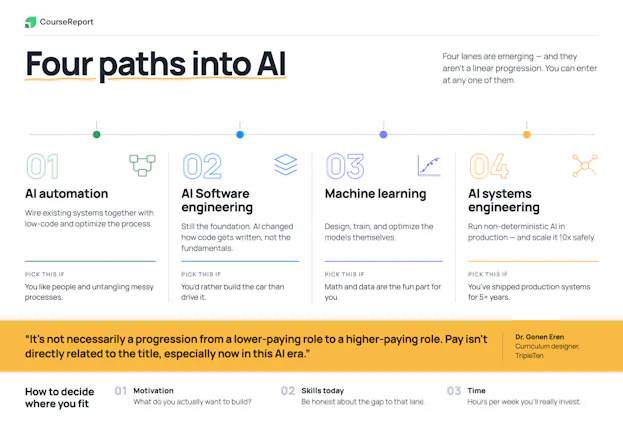
Gonen: We said the roles are merging, but at the same time, we’re seeing convergence toward a few different lanes. I think we can categorize them into four main areas.
The first career path is AI automation, which merges project management with low-code skills. You’re designing systems, finding edge cases, optimizing processes, and bringing different stakeholders together.
Another path is AI/ML, which is focused on optimizing, designing, and training models.
We also still have software engineers building applications, which is changing with AI but is still very relevant.
And one of the new roles emerging is AI systems engineering, which brings together DevOps engineering, product management, process design, and security. You need to take care of many different parts of the system. From what I see, these are the four main pillars of how AI is transforming our industry.
Do you see demand growing for one of those four areas in particular? Which of the four is hiring right now?
Gonen: I think there is demand in all of them. Roles are shifting, and as always when new technology is pushed to the market, those who have the new skills – or the motivation to learn and acquire them – will be in a better position to secure the next jobs.
For those who aren’t following the new technology, I think it will become harder.
Can you give me an example of the type of problem someone might solve in AI automation?
Gonen: Take an e-commerce business, for example. You might have an internal process for handling customer complaints, but it takes too long to respond. There may be several different systems involved – a knowledge base, a form on the website, or a chatbot collecting information – but the internal response still isn’t adequate or timely.
As an AI automation engineer, you need to understand these different components and design a process that connects them. Using low-code systems, you can create a process that’s measurable and can be optimized over time. Optimizing how a business handles customer requests is a good example of AI automation.
Which AI path should you choose, and what should that decision be based on?
Gonen: I think the first thing is motivation – what do you actually want to do? Sometimes people don’t know exactly, but you can feel what interests you. That has been the main driver in my own career. I’ve worked in academia, had my own startup, moved into robotics and IoT, switched to fintech, worked as a project manager, and even took a sabbatical to study fashion design before coming back.
The second consideration is your current skill set. You need to be realistic about the technical skills you have, how much you want to learn, and how much time you’re willing to invest.
If you’re interested in project management, process optimization, or more customer-facing work, AI automation can be a good path. If you’re more interested in math and data science and already have a computer science background, AI/ML could be a good fit.
If you already have software engineering experience and understand how cloud systems and deployments work, AI systems engineering can be a natural next step. It gives you more visibility into how systems work, how you scale them 10x or 100x, and the challenges that come with that.
And software engineering is going to remain relevant because we will always need to build software. Before jumping into some of these more complex paths, you still need foundational skills like databases and at least one programming language.
So this isn’t necessarily a linear path from AI automation to software engineering to AI systems engineering?
Gonen: Exactly. If you want to go into AI/data or AI systems engineering, you need foundational skills in areas like microservices, databases, and deployments. You need to acquire some software engineering skills before you can jump into those areas.
But these are transferable skills that you’ll keep throughout your career, and they’ll continue to serve you over time.
You designed TripleTen’s new AI Systems Engineering program. What were you seeing in the industry that informed how you designed the program?
Gonen: First, we changed how we deliver the knowledge and skills. I’ve taught computer science at the university level, and most programs start with theory and introduce the application at the end through exercises.
We took a different approach with this program: project first, with theory introduced when it’s required. We created a real-world scenario around a virtual company that students join, and then we start giving them problems to solve.
For example, we might tell you there’s a problem with diagnostics, and you need to investigate and find the issue. Then the challenges grow systematically. We might say, “Now you need to scale the system 10x or 100x. What are the problems, and how would you solve them?”
You solve those challenges while we introduce the relevant theory. It’s a different approach, and I think it makes the program very fun to go through.
Is the AI Systems Engineering program full-time? How much time should students expect to commit?
Gonen: The program is designed to be completed over 22 weeks, and we expect students to invest about 20 hours per week. About 75% of that time is spent directly working on projects, with the remaining 25% focused on theory as it’s required.
What will students actually learn in the AI Systems Engineering curriculum?
Gonen: We designed the projects to become progressively more difficult. Engineers come in with different skill sets – someone may be really good with databases, while someone else may be stronger in system diagnostics. Each project includes different tasks, so some will be easier based on your experience, while others will challenge you.
The first project introduces you to the virtual company. You map the system, diagnose problems, and then figure out how you would scale it 10x. You have to defend your approach to an instructor, similar to how you would present it to a CTO.
In the second project, you modernize and redesign the system, including challenges like sharding databases. The third project becomes more operational: We introduce new AI systems, and then hackers start attacking you. You have to secure and defend the system. We have a “chaos lab” where we introduce many different problems for students to solve.
The fourth project focuses more on working with large companies, including security, compliance, grounding AI, implementing rule sets, and managing costs. It starts moving into engineering management.
For the final project, you build an autonomous AI system from scratch. We provide direction and support, but students have to build and defend the system themselves. The goal is to create a project they can keep and showcase afterward.
I’m more on the content side, but I’ll definitely be there for the project defenses.
Do AI systems engineers need to be experts in all of these areas, or do they typically specialize?
Gonen: You can never be fully expert in everything. We want engineers to first have an overview of all the different topics, and then, if they’re interested in specializing in one area, they can go deeper.
We designed the theory in multiple layers. For example, when we introduce production operations or resilience, there are additional layers of theory students can explore more deeply on their own time. This allows us to bring engineers up to date on all of these new topics in 22 weeks, while also giving them opportunities to specialize in areas that interest them.
If someone really enjoys the Chaos Lab, for example, where hackers are attacking the system, they may discover that security is particularly interesting to them. They can then dive deeper into that theory and potentially focus their job search in that area.
What kind of background do students need for the AI Systems Engineering program?
Gonen: It’s definitely challenging. You should have around two years of software development experience or something similar. That could also be experience in QA testing, DevOps, or another role where you’ve worked with real production systems.
We introduce the challenges slowly, step by step, and instructors are there to help if you get stuck. But the idea is that you already have that technical foundation, and we’re helping bring you to the next level.
What’s the difference between systems engineering and AI systems engineering? Is it simply that you’re working on an AI product?
Gonen: You still have all of the traditional systems engineering concerns – monitoring, deployment, evaluation, applications, data, and databases. But now, on top of that, you’re adding AI models and non-deterministic paths, along with all of the problems that come with them.
There are questions around data storage, making sure the AI behaves as expected, and, of course, security. We’ve already seen examples of companies releasing AI chatbots without enough protection around them, and people finding ways to use those chatbots for things they weren’t intended to do.
And now there are many more layers to think about: When a chatbot makes a mistake, how do we trace that error? How do we recover from it? How much space and capability do we give an AI agent?
Those are new challenges that come with adding AI to an existing system. So the systems engineering role is now evolving into AI systems engineering.
If someone wants to become a software engineer in 2026, should they still start by learning a programming language and the fundamentals?
Gonen: My personal opinion is that the fundamentals always stay. Database design, distributed system patterns, cloud networking, security, and technical communication – those don’t change. What changes is how we create software.
Instead of manually writing all of the code, we’re now generating much of the code we produce, but it’s still reviewed by humans. We can’t yet fully trust non-deterministic systems.
Learning a programming language is still required. In the AI Systems Engineering program, we teach Python. Even if you’re doing low-code development, you need to know some programming basics. You’ll also still need databases. AI doesn’t replace the database, so you need to understand how we store data, optimize it, and access it quickly.
AI doesn’t replace everything. If you’re interested in software engineering, I think it’s never too late to start learning.
With AI, can anyone become a software engineer without learning to code?
Gonen: I wouldn’t call that software engineering. What we defined earlier as AI automation engineering is very possible. You don’t need to learn all of the big concepts because, instead of designing the systems themselves, you use existing systems, connect them together, and optimize the processes.
I think it’s amazing that anybody can jump in, learn very quickly, and start designing automations.
But when you talk about engineering – software engineering, systems engineering, data engineering – you’re talking about building the systems themselves. It’s like building the car rather than driving it. Then you really need to invest and acquire those skills first.
So how should someone who wants to work in AI decide what to learn first?
Gonen: It’s about what you want to do and what you want to build. Do you want to optimize systems? Are you more of a person who likes interacting with people and bringing different stakeholders together? Or do you want to go deep into the technical side and design systems?
It’s about choices. There are opportunities in both areas, and it depends on what you want.
It’s also not necessarily a progression from a lower-paying role to a higher-paying role. That can change a lot depending on the person. Pay isn’t directly related to the title, especially now in this AI era.
Find out more and read TripleTen reviews on Course Report. This interview was produced by the Course Report team in partnership with TripleTen.

Written by
Liz Eggleston, CEO and Editor of Course Report
Liz Eggleston is co-founder of Course Report, the most complete resource for students choosing a coding bootcamp. Liz has dedicated her career to empowering passionate career changers to break into tech, providing valuable insights and guidance in the rapidly evolving field of tech education.


Comments
No comments yet. Start the conversation.
Sign in to join the conversation.
Sign in to comment